The long roll
In a room full of twenty-year-olds who just came off a rugby pitch, the one thing you learn fast is that you can't beat them at their game. The training philosophy I built around being old, slow, and un-athletic – pressure over speed, technique over strength, and why the goal is still being on the mat at sixty.
Originally written Sep 2025
The first thing I noticed in the beginner course was the other people.
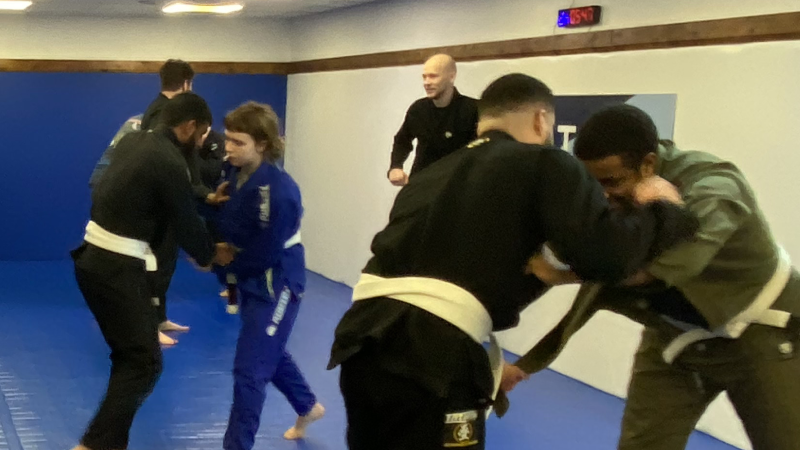
Eight weeks, twelve of us, most of them in their twenties. The kind of twenty-somethings who looked like they'd just walked off a rugby pitch – broad, quick, wiry, and completely unbothered by the thought of being thrown onto a mat by a stranger. I am forty. I am none of those things. I am not quick. I am not strong. I overheat easily, and my hamstrings haven't been fully straight since about 2007. I signed up anyway.
The realisation didn't come during the eight weeks. In the beginner course, everyone's lost, everyone's tapping, and the gap between us hasn't really opened yet. It came in the months after, once the structured sessions ended and I was rolling with people properly for the first time. That's when it became obvious I couldn't beat them at their game.
Not sad. Just clear. And once it was clear, I could start building something different.
The wrong game
Every coach will tell you BJJ is technical, not athletic. They're right, mostly. But in a beginner course at forty, surrounded by people who are both more athletic and picking up the techniques at the same rate, the theory feels thin.
The instinct is to try harder – more mat time, more YouTube, more drilling. Close the gap with volume. That instinct is wrong, and it took me a while to understand why. The twenty-year-olds don't just have more physical capacity; they recover faster. They can do more. The gap isn't closeable by doing what they do, only slower. The only way through is to build a different game entirely – one that works for the body and the life you actually have, not the one they have.
That's what the long roll is. A deliberate choice to stop trying to win the wrong fight.
The philosophy
The long roll isn't a cop-out. It's a set of choices made from the same place any good decision comes from: look at the constraints, work with them, and build something that holds.
Pressure over speed. I can't outpace a twenty-year-old, but I can sit on one. Pressure passing – controlling someone's hips, killing their guard, making them carry my weight – doesn't require explosiveness. It requires patience and positioning. The person at the bottom is doing all the work, trying to escape. I'm just staying heavy. Explosive scrambles burn through energy fast; sustained positional pressure is comparatively economical. Slow is, genuinely, the more efficient strategy.
Technique over strength. Without technique, strength decides. With technique, something else does: weight distribution, timing, and angle. A correctly positioned pass works on someone twice my strength. A badly positioned one doesn't work on anyone. So every movement has to justify itself technically. There's no plan B if the technique is wrong.
Control over scramble. When it breaks into a scramble, the athlete usually wins. So I try not to let it scramble – slow it down, establish position, and keep the contact.
This isn't defensive; it's selective. A patient game played by someone comfortable with sustained contact is its own kind of aggression.
Recovery is part of the game. I can't train five days a week. I have a job, a family, and a body that needs proper time between sessions. The work that happens off the mat – the gym sessions to protect my joints, the walking that shifted most of the weight I've lost, the sleep – isn't supplementary. It is the game. A grappler who burns out or gets injured isn't on the mat, and the only way to keep improving is to keep showing up.
The reality
I train two or three times a week when life allows. That used to feel like a limitation. It still is one, technically – but it's also a forcing function. Every session has to count, which means I'm never just showing up to roll without a focus.
The gym sits alongside the mat work. Not to get strong in the way a twenty-year-old lifts, but to stay structurally sound – joints that work, a back that holds, and shoulders that don't become a problem later on. Walking has been the other piece. Losing weight at forty is a different battle than at twenty-five. It's slower, more deliberate, and mostly won by moving consistently rather than dramatically. I got to a level I'm happy with, and the walking stays regardless.
None of this is the romanticised version of training. It's the version that fits in the gaps of real life – and it's working.
What it changed
The game I'm building is slow and deliberate, and it looks nothing like what the twenty-year-olds are doing. It's also still improving. Not at their pace, not with their ceiling – but month to month, the techniques are cleaner, the pressure is heavier, and the panicked scrambles I used to fall into happen less often.
My first tournament is coming. Not competitive by what a twenty-year-old would consider competitive, but a real event where the long roll philosophy gets tested in the one place you can't fake anything. I don't know exactly what will happen. I know what game I'm going to try to play. That's enough to get on the mat.
A note on the long roll
The name has two meanings, and both are intentional.
A long roll is a long grappling session – the kind where you're still moving forty minutes in, not because you're tough but because you're paced right. The long roll is also the longer thing: still on the mat at fifty, still improving at sixty, and playing a game that doesn't require wrecking yourself to sustain it.
The sloth framing already exists in grappling – Sloth Strength is a programme for older grapplers built around similar principles, and it's worth knowing about. The long roll is my own version, built from my constraints, not theirs.
The grappling world is obsessed with the short game. Grind harder, peak faster, win now. Most of that content is made by people in their twenties for an audience it flatters. At forty, training two or three times a week around a real life, the goal isn't to peak for a season. It's still tough to be on the mat at sixty. That's a different optimisation problem, and it produces a different kind of game. Slower. Heavier. More patient. More sustainable.
More mine.