The list
The BJJ instructional market has over 3,000 titles. Roger Gracie won multiple world absolute championships with fewer techniques than you can count on two hands. My complete game plan – twenty-one techniques, organised by stage, chosen for high win percentage and my own constraints.
Originally written Mar 2026
Every week there's a new technique.
It gets shown once. Maybe twice if you ask. Then you're drilling it, then you're rolling, and somewhere in the fifteen minutes between demonstration and sparring, you're supposed to have absorbed it well enough to use it against someone who has no intention of making it easy.
I'm oldish. I take longer than most. By the time I'd been training for a few months, I had a loose collection of techniques I'd been shown and a much smaller collection I could actually find when I needed them. The gap between those two lists was the problem.
A personality from the morning class told me I needed a plan. Not more techniques – a plan. Something to work through systematically, rather than adding to the pile every week and hoping it sticks. That conversation changed how I trained.
Why fewer is more
Roger Gracie is widely regarded as one of the greatest BJJ practitioners who has ever lived. He won the absolute division at multiple IBJJF world championships – the division where you fight everyone, regardless of weight class – by submitting almost everyone he faced. His game was famously simple: secure top position, work to mount a cross-collar choke or go to the back for the rear naked. He didn't use flash techniques or a constantly expanding library. He used a handful of moves, applied with precision born of drilling the same things thousands of times.
The instructional market tells a different story. There are over 3,000 BJJ titles available right now. Thousands of hours of content covering every position, every opponent type, every scenario. Most of it is good. None of it helps when you're on your back in a real role trying to remember what you're supposed to do next.
Volume isn't the answer. Depth is. And depth requires a smaller menu.
Defence first
The staged approach comes from the logic of what actually works at white and blue belts. If you can't survive, you can't improve. The game starts with staying safe.
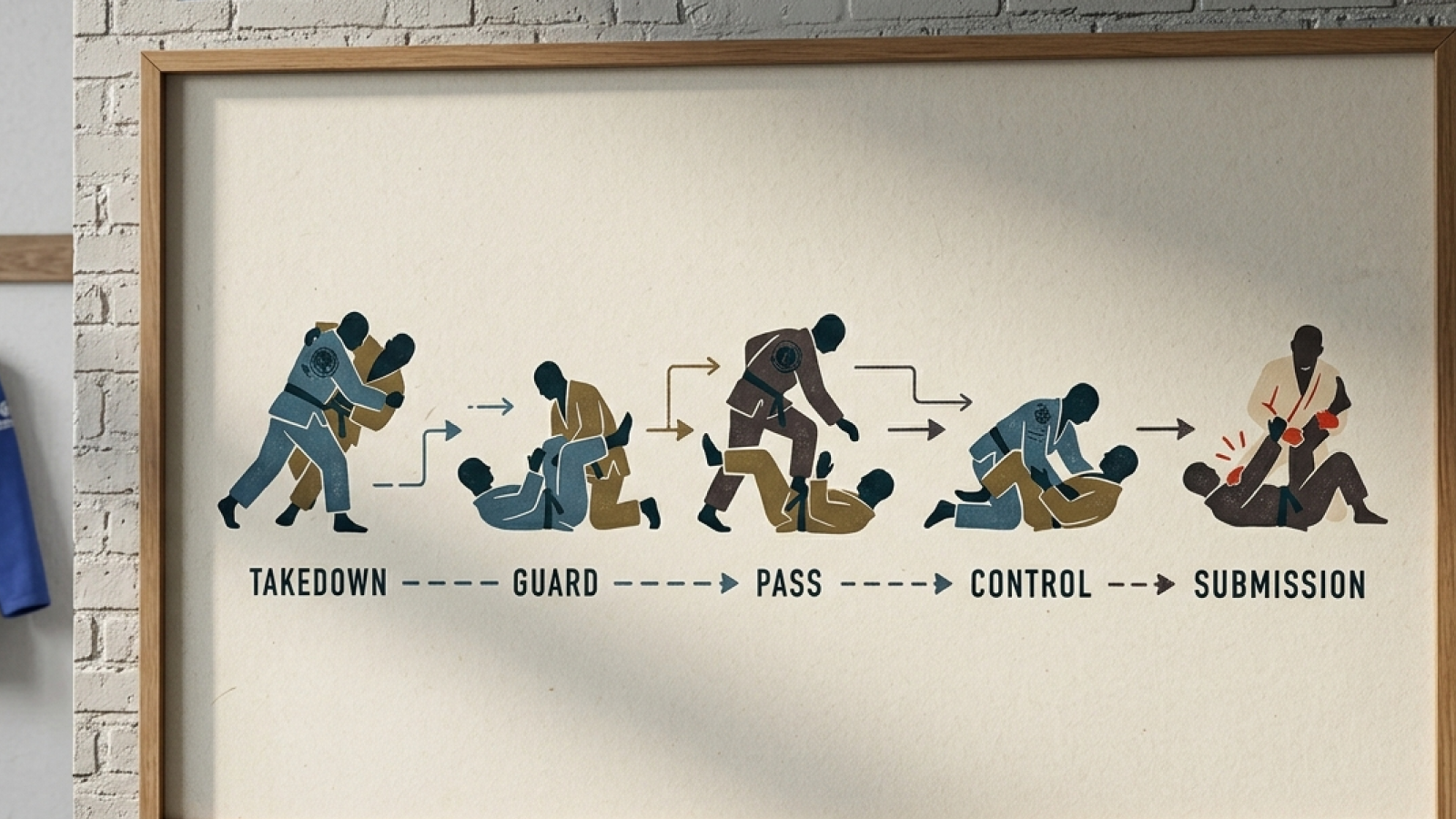
Survival → guard recovery → passing → control → submission. Each stage depends on the one before it. There's no point knowing a dozen submissions if you can't maintain the position to set them up. There's no point maintaining top control if a scramble sends you back to the bottom every time.
Defence first. Then retention. Then attack.
The order is deliberate – and it's the order the list is built around.
The list
Twenty-one techniques, organised by the order you'd encounter them in a roll, from the moment contact is made to the moment it ends.
It starts with getting to the mat. Two options: an ankle pick from a collar tie, learnt from Shintaro Higashi, and a pull straight into Z-guard based on Lachlan Giles's half guard system. Neither requires athleticism. Both get me to a position I'm comfortable in.
From guard, the primary pass is Bernardo Faria's over-under, with Lachlan's knee-cut as the backup. On the bottom, Faria's underhook sweep is the go-to, with Lachlan's knee-block sweep when that's shut down. Guard recovery runs through Priit Mihkelson's Running Man – the same principle appears several times across the list, which is not an accident.
The top control chain follows a clear progression: establish knee-on-belly using Faria's lapel and far-hip post, transition to mount using the cross-choke threat from Gustavo Gasperin's system, move from side control to mount via Tom DeBlass's hip-switch knee-slide, then mount to back using Roger Gracie's arm-across take. Each position sets up the next. None of them requires a scramble.
Submissions come at the end of the chain, not the beginning. Kimura from side control (Faria), cross-collar choke from mount (Roger Gracie), and bow and arrow from the back (Lachlan Giles). Three finishing positions, three techniques. Enough.
The escapes are the largest section and the most drilled. Mount uses Henry Akins's and Kurt Osiander's crunching elbow escape. Side control uses Priit's Running Man again. Knee-on-belly uses John Danaher's elbow wedge. Back escape runs through Priit's hidden posture – marked critical, drilled most. Turtle uses Priit's sitting turtle and panda concepts. The default bottom guard is Z-guard per Faria; from the top in closed guard, a standing posture break is also Faria.
The attributions matter. Every technique here comes from someone who has thought deeply about that specific position at a world-class level and built a system around it. Learning the technique means learning the context it comes from.
How I chose them
The research behind the list came from competition data – the rear naked choke accounts for nearly half of all submissions at the elite level and the armbar for roughly a fifth. The top five techniques account for more than half of all finishes. That data makes the selection easier: start with what works most often.
I used AI to map high-percentage techniques to my specific style and constraints – older, not particularly athletic, and building a pressure game. Not as a replacement for coaching, but as a research layer to help identify the right corners of the instructional library. It pointed me toward the right instructors. Bernardo Faria's pressure-first system, Priit Mihkelson's defensive structure, and Roger Gracie's mount control. The mat and the coaches made it stick.
What I'm still working on
The defence has got reasonably solid. Priit's framework – Running Man, Hidden Posture, and the Panda – has given my escapes a structure they didn't have before.
The honest part: I rely on the turtle too much. It's become a default when things get uncomfortable, and it exposes my neck more than it should. The back escape is marked critical on the list for exactly this reason. Knowing the problem and having fixed it are two different things – and that gap is what the drilling plan is for. No more techniques. More reps on the ones that matter.
A note on the list
A list of techniques is not a game plan. The list is the inventory. The game plan is the order you try them in, the positions you're aiming for, and the transitions you've drilled enough to find under pressure.
Mine starts with defence because that's where every roll starts – with survival. Once the survival holds, the retention improves. Once the retention holds, the passing opens up. Once the passing is reliable, the control chain follows. The submissions are at the end of the list because they're at the end of the game.
Twenty-one techniques. The same ones, drilled deeper. That's the whole plan.